

Although we weren't going to the deep south today, and with a planned journey time of around an hour and a half, we had a 6.00 am breakfast and left at 7.00. The idea was to maximise our work time second day at Batn Al-Ghul and also provide enough time to trek up to Fassuah Ridge, which many of this year's team have not seen. As so often happens with plans in projects like these they were best laid but altered by events.
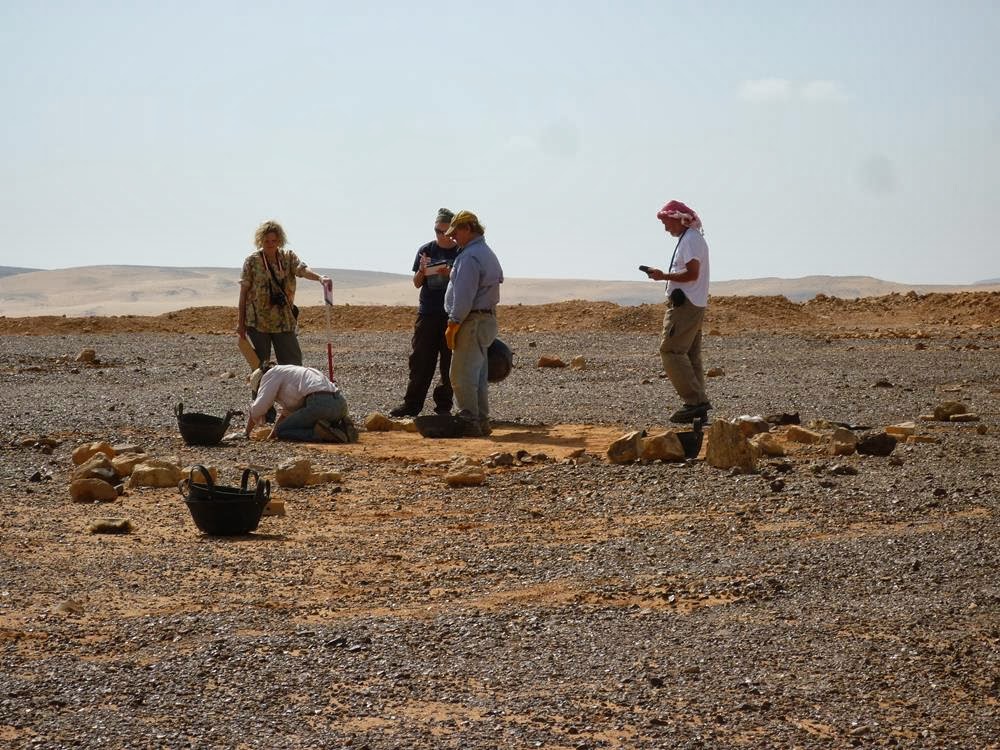
The weather this morning was really lovely, warm enough to not need a jacket but not searingly hot, a gentle breeze, blue skies and occasional fluffy clouds. Perfect conditions to continue with the excavation of the tent rings in the Northern late Ottoman Camp.

 |
| Excavating, transporting and sieving for finds |


.jpg) |
| Salah,one of our drivers, brought his son Ahmad to join us in the dig today |

 |
| Ahmad - archaeologist of the future? |
 |
| Thinking on a rock in the desert |


 |
| Anna tries detecting |
Anna our finds supervisor has been part of the team for a while, and this is in fact her seventh season. During this time she has never managed to find so much as an Ottoman army button. Today we persuaded her to have a quick go with one of the metal detectors, and after a brief bit of training she got a signal inside one one the rings. With more advice on how to reveal her find she dug, scraped and hand sifted the sand with an archaeological trowel to eventually unearth a fantastic find - a complete, (if a little bent) Ottoman army officers's personal seal. The shriek of delight could probably have been heard in Ma'an.


Elsewhere the rather rare sight of Neil Faulkner holding a trowel the right way round and pointing it at a feature close enough to do damage was thought worthy of recording for posterity.



 |
| The mighty goofa, used to transport excavated material for sieving, and tools to and from the site |


 |
| Lunch! |
We didn't get to see Fassuah ridge today. The rain came back mid afternoon and the decision was hastily made to decamp for the day. Tomorrow we will be back here again and the plan is to make the Fassuah trip early in the day, provided the weather is suitable. If we do get there in good weather, the place is located in a fantastic, high position overlooking the wadi, and the views and pictures are usually extremely impressive. Hopefully that will be so and if you check back on the blog tomorrow they will be published here.
Now to answer yesterday's questions. The artefacts we are finding at Batn Al-Ghul almost certainly represent both the mainstream life of a late Ottoman army camp mixed in with some items lost by passing travellers. The camp site sits atop the plateau at the head of the escarpment down into Southern Jordan, and the route is one which has been used for thousands of years by pilgrims on their way to Mecca and Medina, by traders travelling to buy and sell all manner of wares, and by the Bedouin who travel in huge numbers with their families, possessions and animals both north and south as the seasons change. Indeed, one year whilst working on the hilltop fort at Fassuah, we watched the mass migration of thousands of people and animals across this plain and down into the wadi below. This was a truly inspiring scene, evoking the spirit of the same activity having taken place over millennia.
Consequently the finds here in the camp itself are mainly Ottoman military in nature, but there is a sprinkling into these of lost things from all of the groups above, including jewellery, coins and other artefacts. A true reminder of the multifaceted nature of this evolving conflict landscape.
Which leads on to the second question - the remote desert in Jordan is used by the military here for tank training and other live fire army and air force exercises. This is because the locations are far away from villages and most people, and one supposes the idea is that the landscape and the odd buildings here, much of which are damaged in the course of this training, are of low value. Consequently we come back every year to find sites we have worked on in increasingly destroyed condition.
Now to answer yesterday's questions. The artefacts we are finding at Batn Al-Ghul almost certainly represent both the mainstream life of a late Ottoman army camp mixed in with some items lost by passing travellers. The camp site sits atop the plateau at the head of the escarpment down into Southern Jordan, and the route is one which has been used for thousands of years by pilgrims on their way to Mecca and Medina, by traders travelling to buy and sell all manner of wares, and by the Bedouin who travel in huge numbers with their families, possessions and animals both north and south as the seasons change. Indeed, one year whilst working on the hilltop fort at Fassuah, we watched the mass migration of thousands of people and animals across this plain and down into the wadi below. This was a truly inspiring scene, evoking the spirit of the same activity having taken place over millennia.
Consequently the finds here in the camp itself are mainly Ottoman military in nature, but there is a sprinkling into these of lost things from all of the groups above, including jewellery, coins and other artefacts. A true reminder of the multifaceted nature of this evolving conflict landscape.
Which leads on to the second question - the remote desert in Jordan is used by the military here for tank training and other live fire army and air force exercises. This is because the locations are far away from villages and most people, and one supposes the idea is that the landscape and the odd buildings here, much of which are damaged in the course of this training, are of low value. Consequently we come back every year to find sites we have worked on in increasingly destroyed condition.


